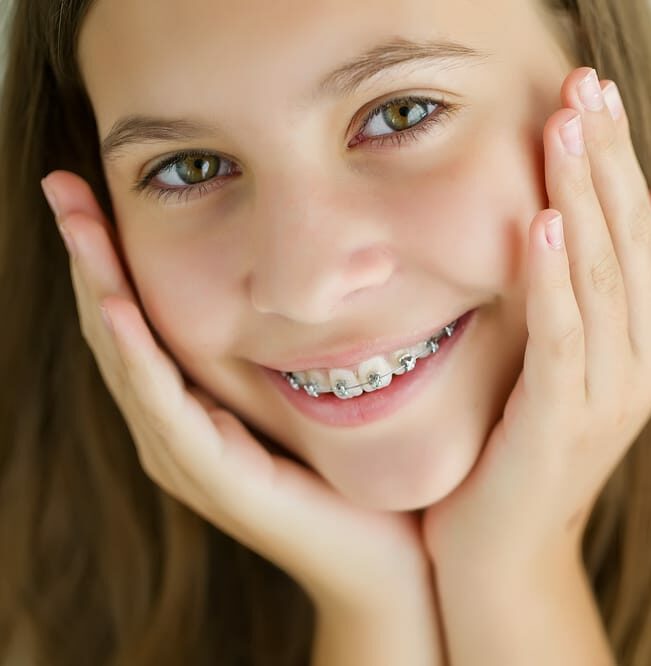
Parents ask us about braces long before there is anything to do about them, usually the moment a permanent front tooth comes in at an angle. That is a reasonable instinct, and the honest answer is often wait, we are watching this.
Here is what we watch, what actually predicts a need for treatment, and when we refer.
Why Does Age Seven Come Up?
The recommendation is an orthodontic evaluation around age seven, not braces at seven. By then the first permanent molars and front teeth are usually in, which is the earliest point at which the bite and the available room become readable.
What an Early Evaluation Is Looking For
Most children evaluated at seven need nothing but a recheck in a year or two. A minority have a problem where acting early is genuinely easier than waiting, and that is who the early look is designed to catch. Finding nothing is a normal, useful result.
What We Check at Every Regular Visit
At every checkup we are looking beyond cavities. We track how much room exists for the teeth still coming, whether the upper and lower arches match, whether teeth are erupting in sequence, and whether baby teeth are being lost too early or too late. X-rays let us see teeth that have not appeared yet, including the occasional missing or extra tooth, which changes planning considerably.
What Signs Are Worth Mentioning to Us?
None of these mean braces tomorrow. All of them are worth a look, and pointing at the thing that has been nagging you is more useful than waiting to be asked.
- Crowding or teeth erupting badly out of line
- A permanent tooth that has not come in long after its partner on the other side
- Upper teeth that cover the lowers too far, or lower teeth that sit in front of the uppers
- A crossbite, where the jaw shifts to one side to close
- Teeth that do not meet at all in front, often with a tongue or thumb habit
- Persistent thumb sucking past about age five
- Mouth breathing, chronic congestion, or snoring
- Difficulty chewing, or biting the cheek repeatedly
- A jaw that clicks or shifts noticeably
- Early loss of a baby tooth, which lets neighboring teeth drift
Which Signs Get Acted On, and Which Get Watched?
This is the table we end up drawing for parents who want to know whether their child’s particular issue is a now problem or a later problem.
| What we see | Why it matters | Usual next step |
|---|---|---|
| Crossbite, with the jaw shifting to close | The bite adapts around the shift as the child grows | Early referral; an expander is far simpler now than later |
| Severe crowding at age seven or eight | Room runs out as permanent teeth arrive | Referral for records; early treatment can reduce later extractions |
| Protruding upper front teeth | Higher risk of injury during the fall-prone years | Referral, plus a mouthguard for sports in the meantime |
| Early loss of a baby molar | Neighboring teeth drift into the space | A space maintainer, held until the permanent tooth arrives |
| Thumb sucking past about age five | Sustained force reshapes the bite | Habit work first, appliance only if that does not resolve it |
| Mouth breathing, snoring, chronic congestion | Associated with a narrower upper jaw over years | Raise with your pediatrician as well as with us |
| A permanent tooth much later than its partner | May be impacted, missing or blocked | An x-ray, then a decision about monitoring or referral |
| Mildly crooked front teeth at age seven | Very common and often self-correcting as the jaw grows | Watch and recheck; no treatment needed yet |
The right-hand column is a general pattern, not a diagnosis. Two children with the same crossbite can need different timing depending on how much growth is left.
Which Problems Are Easier to Fix Early?
Some issues are meaningfully easier to correct while a child is still growing, and those are the ones worth catching before the teenage years.
Crossbites and Narrow Upper Jaws
An expander can widen the upper arch while the growth suture is still open, which is far simpler and less invasive than the alternatives available once growth is finished.
Severe Crowding
Creating room early can reduce the chance of needing permanent teeth removed later, and can shorten the time in braces when they eventually go on.
Protruding Upper Front Teeth
Reducing the protrusion lowers injury risk during exactly the years children are most likely to fall off something.
Habits Affecting the Bite
Thumb sucking and tongue thrust are easier to address before the bite has fully adapted around them. Our page on oral appliances explains some of the devices involved, and Teeth 101 on braces covers the basics of orthodontic care.
The Habits That Shape a Bite
Teeth respond to forces, and small forces applied for years matter more than large ones applied briefly. The habits that change how a bite develops are thumb and finger sucking, prolonged pacifier use, tongue thrusting, nail biting, and chronic mouth breathing.
Why Mouth Breathing Deserves Special Mention
A child who cannot breathe comfortably through the nose tends to hold the tongue low and the mouth open, and over years that pattern is associated with a narrower upper jaw and a longer facial growth pattern. If your child snores, breathes through the mouth at rest, or has chronically enlarged tonsils, raise it with your pediatrician as well as with us.
When Do We Refer, and What Happens Then?
We refer when the bite or spacing needs a specialist’s plan rather than observation.
What the Orthodontic Consultation Involves
An initial consultation is usually free, involves records and x-rays, and ends with one of three answers: treat now, monitor and recheck, or nothing needed. Being told to monitor is a good outcome, not a wasted visit. It means the problem has been measured and put on a clock.
What We Can and Cannot Do at This Stage
We can protect space when a baby tooth is lost early, monitor eruption, address habits, and refer at the right moment. We cannot straighten permanent teeth, and we will not tell you a child needs an appliance when watching is the honest recommendation. If someone has offered your child expansion or early braces and you are unsure, a second opinion is entirely reasonable, and we will help you get one.
Keeping Teeth Healthy Through Orthodontic Treatment
Braces make brushing harder exactly when it matters most. Plaque parks around brackets, and the white marks left on enamel afterward are permanent.
During treatment we recommend cleanings on schedule, extra fluoride, careful brushing around every bracket, and a floss threader or water flosser at night. Our brushing and flossing guide is a good refresher for a child who is about to start. Decay around brackets is common enough that we stay in the picture throughout, rather than handing your child over and waiting two years.
Frequently Asked Questions About Braces and Timing
Should we wait until all the baby teeth are gone?
For most children, treatment does happen in the early teens once the permanent teeth are in. Waiting is only a problem for the specific issues listed above, which is the whole reason for an early look.
Will thumb sucking really cause this?
Sustained sucking past about age five can, yes. Before that, most children stop on their own and the bite recovers without help.
Do baby teeth need to be straight?
Not necessarily. Some spacing between baby teeth is a good sign, because the permanent teeth are wider. Very crowded baby teeth, on the other hand, often predict crowded permanent ones.
Can you tell me now whether my child will need braces?
Often, roughly. We would rather give you an honest estimate with a recheck date than a guess dressed up as certainty.
Does early treatment mean my child avoids braces later?
Sometimes, but not usually. Early treatment fixes a specific problem while it is easy; many of those children still have a shorter, simpler course of braces as teenagers.
Bring It Up at the Next Visit
If something about your child’s teeth or bite has been nagging at you, point at it. We will tell you plainly whether it needs attention now or a note in the chart.
Learn about our pediatric dentistry in Frisco, meet the team at our office, or schedule a checkup.